"Qual at scale" means collecting open, in-their-own-words answers from hundreds of people as easily as running a survey. Skimle Ask does it with a short AI interview: quick taps for ratings and choices, then a conversation that asks why. Every tap becomes a number you can chart, and every reply is coded into themes you can count.
That is the short version. The rest of this guide shows how it works on one realistic study: a home and garden shop asking its customers about their last visit. You will see the guide we built, the question types it uses, how branching and follow-ups behave, what respondents actually see and type, and what happens behind the scenes when 24 responses come back.
Why do long rating surveys tell you so little?
Most customer experience surveys are built from the same brick: a statement and a 1 to 5 scale. One of them is useful. Fifty of them in a row is how a store ends up knowing its satisfaction score to one decimal place and nothing about why it moved.
The research on survey length is consistent. In a web survey experiment published in Public Opinion Quarterly, Galesic and Bosnjak found that the longer the announced length, the fewer people started and finished, and that answers to questions placed later in the questionnaire were faster, shorter and more uniform than answers near the beginning. That uniformity has a name in grid questions, "straightlining": a tired respondent picks 3 down the whole column. The one open box at the end ("Any other comments?") collects a "no" or nothing at all.
Asking open questions in a chat format helps. In a field study of about 600 people published in ACM Transactions on Computer-Human Interaction, Xiao and colleagues compared a standard Qualtrics survey with an AI chatbot asking the same open-ended questions. Across more than 5,200 free-text responses, the chatbot drew significantly more engagement and better answers on informativeness, relevance, specificity and clarity.
The practical lesson is to ask fewer closed questions, ask the open ones as a conversation, and let the closed answers steer what the conversation asks about. That is the design Skimle Ask is built around.
Why does "qual at scale" suddenly have a name?
In December 2025 Anthropic introduced Anthropic Interviewer, a Claude-powered tool for running structured conversations, piloted with 1,250 professionals. In that pilot, 97.6% of participants rated the experience 5 or higher out of 7 and 99.12% said they would recommend the format. Anthropic then used it to interview 80,508 Claude users in 159 countries and 70 languages, and described the result as the largest and most multilingual qualitative study ever conducted.
That put "AI interviewer" and "qual at scale" into conversations they had not been part of before. Skimle Ask is the same idea sized for a team, a customer base or a community: you do not need a model lab's research team to run one, and you get the analysis back in the same place as the answers.
Skimle Ask does not replace a skilled human interviewer. A 45-minute depth interview on a sensitive topic, or a study that has to hold up in a journal, still needs a person. We cover where the line sits in AI interviewing vs human interviewing. Skimle Ask is the lightweight end of the spectrum: five minutes, on a phone, with hundreds of people at once.
What is Skimle Ask?
Skimle Ask is an AI-conducted interview that anyone can set up in minutes and share as a link. Respondents open it on a phone or laptop, answer a mix of quick closed questions and open questions, and the AI interviewer follows up where an answer is thin. There is no account, no app and no scheduling for them. You can try one yourself by answering this example employee experience interview.
It sits in a different place to the tools you already use:
| Tool | Simple for | What you get back |
|---|---|---|
| Doodle | Finding a time everyone can do | A slot |
| Google Forms, Typeform, SurveyMonkey | Collecting structured answers and counting them | Scores and a column of short open-text replies |
| Skimle Ask | Collecting scores and the reasons behind them, in people's own words | Metadata columns from the taps, themes from the conversation, and both linked to each respondent |
If you are choosing between these tools for a specific project, our comparison of Typeform, SurveyMonkey, Google Forms and Skimle goes into more depth.
Watch it: a 50-question survey vs a five-minute Skimle Ask
The video below runs the whole example in under two minutes: a shopper giving up on a 50-question rating survey, the same shopper answering the Skimle Ask version on a phone, and then the setup and analysis behind it.
How does Skimle Ask work? A fully worked out customer experience example
Harbour Street Home & Garden is a fictional independent shop that sells plants, compost, paint and hardware. The store manager wants to know how customers rate their visits and, more importantly, what would bring them back more often. The old approach was a 50-question satisfaction survey. The Skimle Ask version has six questions and takes about five minutes.
To build it, the manager typed one sentence into Skimle: "Customer experience at Harbour Street Home & Garden: how satisfied shoppers are with our staff, checkout, product range and prices, and what would make them visit more often." Skimle drafted an interview guide in under a minute. We then edited it into this:
| # | Question | Type | What happens next |
|---|---|---|---|
| 1 | How often do you shop with us? | Multiple choice | Answer is instant; becomes the segment for later comparisons |
| 2 | Overall, how would you rate your last visit? (1 to 5) | Multiple choice | An AI follow-up asks for the main reason behind the score, up to two probes |
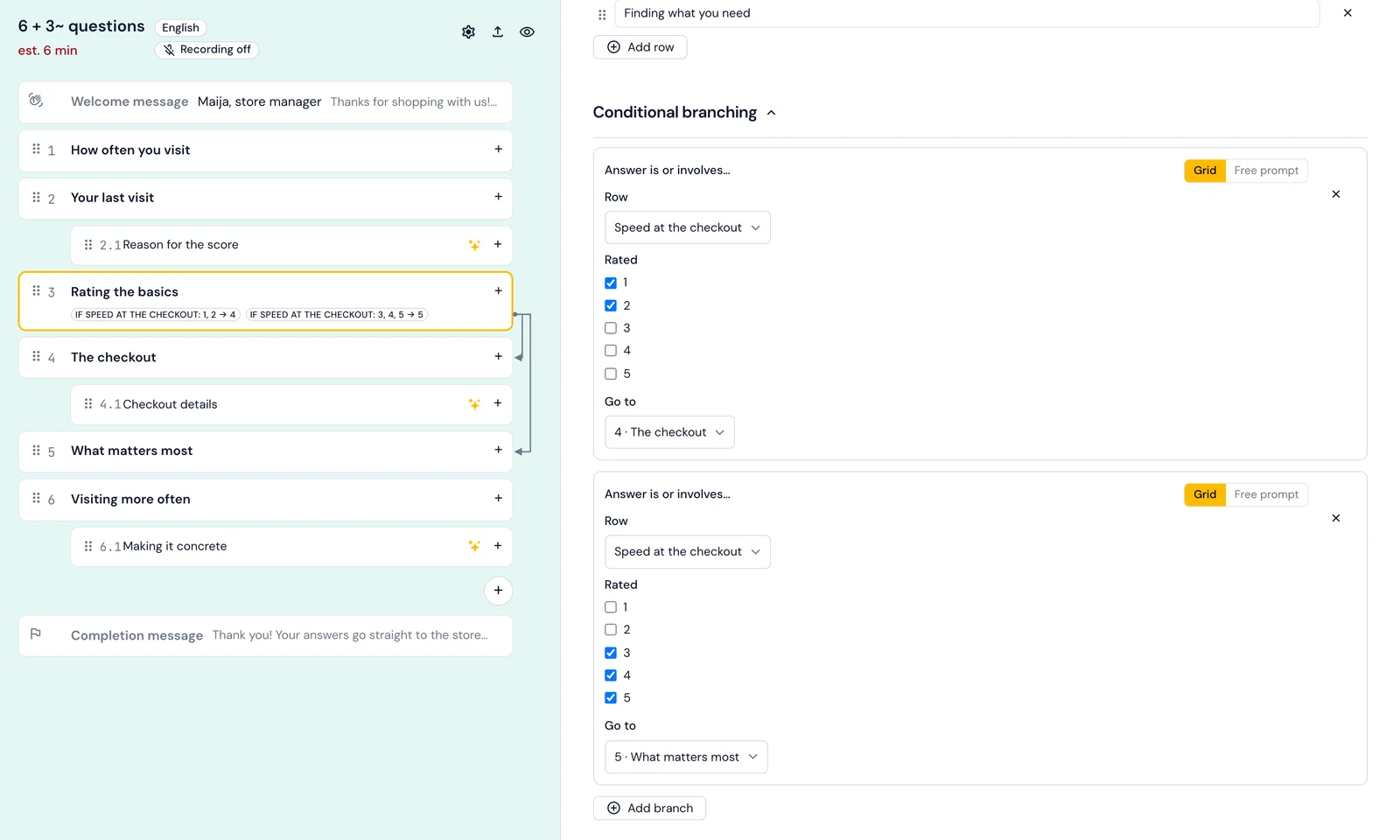
| 3 | How would you rate us on staff, checkout speed, range, value and finding things? (1 to 5) | Rating grid | Branches: checkout rated 1 or 2 goes to question 4, otherwise skips to question 5 |
| 4 | You rated the checkout low. What happened when you went to pay? | Open | Up to two AI probes on wait time, tills open and whether they nearly left |
| 5 | Which of these matters most to you, and which least? | Best and worst | Two taps |
| 6 | What is the one thing that would make you visit us more often? | Open | Up to two AI probes to make the idea concrete |
The screenshot below shows that guide in the Skimle editor, with question 3 open. The two chips under it are its branches, and the arrows on the right show where each one jumps.
What does the respondent actually see?
We ran the interview with a set of 24 test respondents: scripted shopper personas typed by a browser robot, answering the live survey link so that every follow-up, branch and analysis step below ran for real. The interviewer's questions are the AI's own; the shoppers' answers are ours. Treat the numbers that follow as an illustration of the workflow, not as findings about real shoppers.
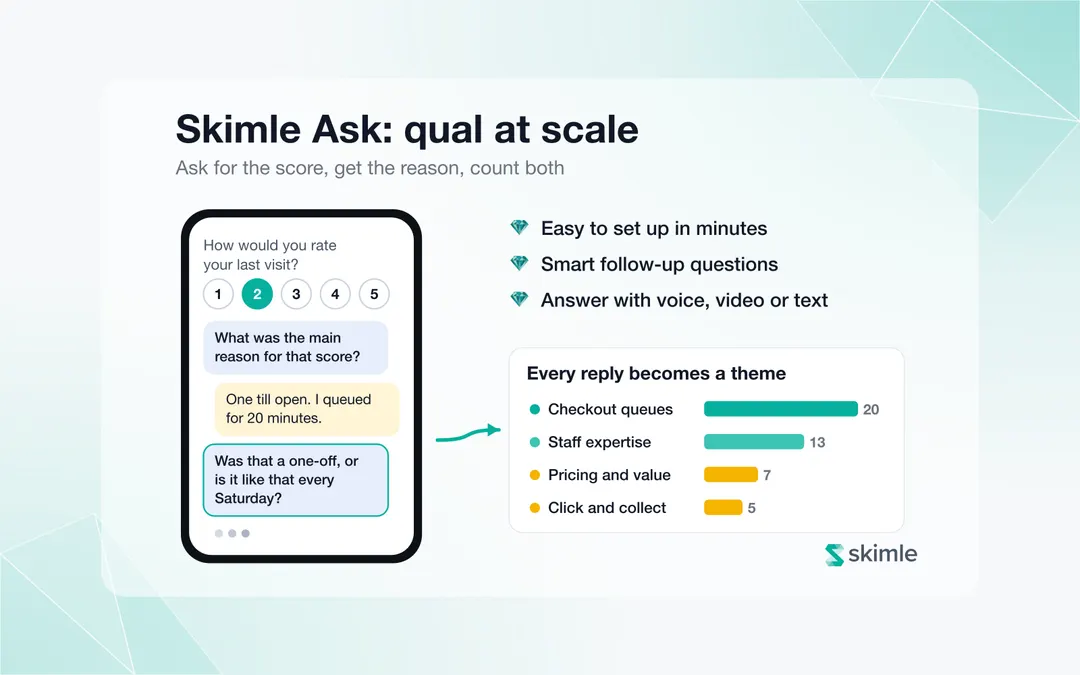
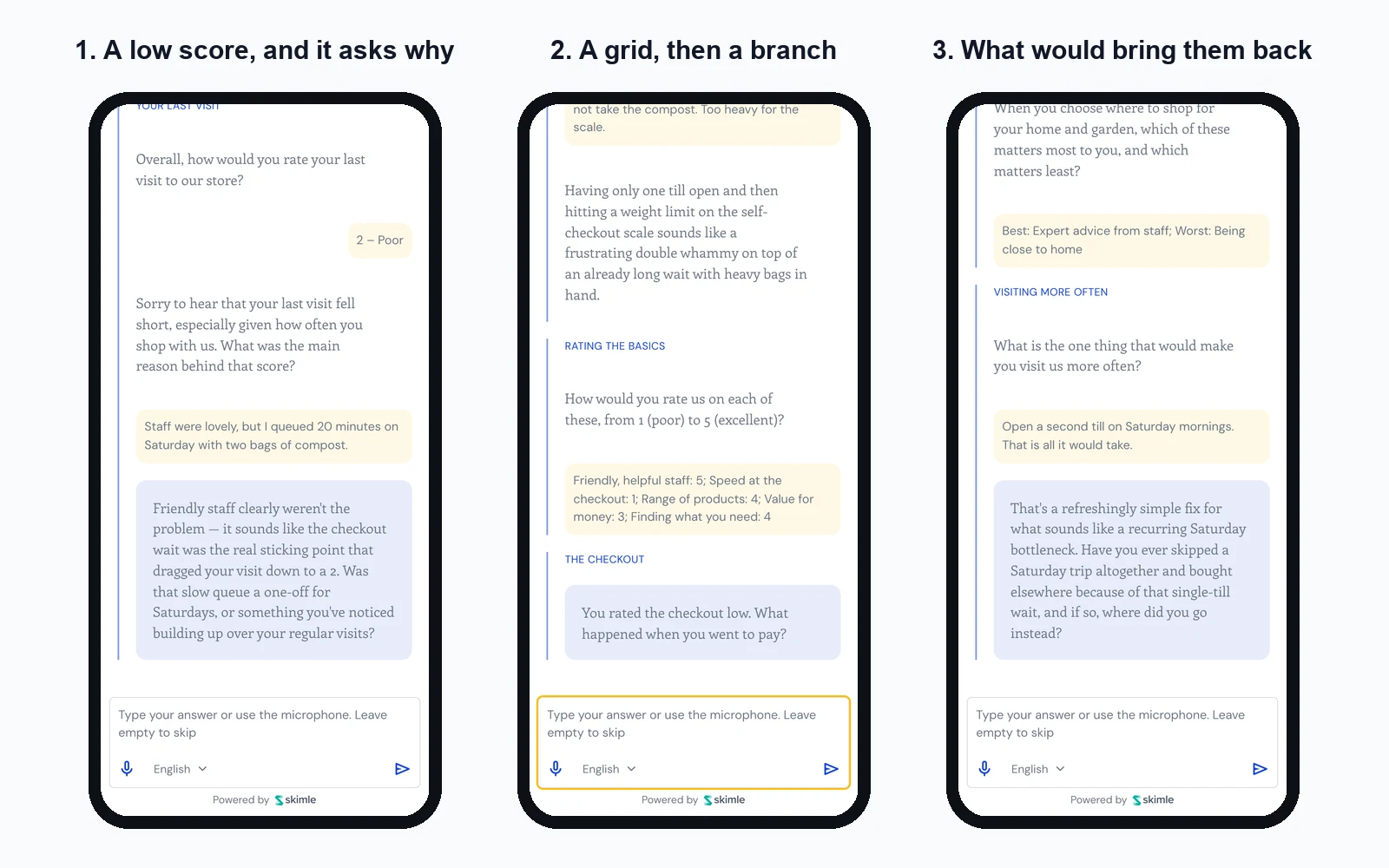
Here is how one of them, a weekly customer, went. The first two questions take two taps. The rating of 2 is where a normal survey would move on, and where Skimle Ask asks why:
Interviewer: Sorry to hear that your last visit fell short, especially given how often you shop with us. What was the main reason behind that score?
Shopper: Staff were lovely, but I queued 20 minutes on Saturday with two bags of compost.
Interviewer: Friendly staff clearly weren't the problem. It sounds like the checkout wait was the real sticking point that dragged your visit down to a 2. Was that slow queue a one-off for Saturdays, or something you've noticed building up over your regular visits?
Shopper: One till open, and the self-checkout would not take the compost. Too heavy for the scale.
The follow-up does two things a static form cannot. It uses the frequency answer from question 1 ("given how often you shop with us"), and it separates the two things the shopper mentioned (staff and queue) to find out which one drove the score.
Next comes the rating grid: five rows on one screen, rated in five taps. Because this shopper gave checkout speed a 1, the branch sends them to question 4, which only the 9 shoppers who rated the checkout 1 or 2 ever see. The other 15 skip straight to question 5. Nobody who was happy with the till is asked about it.
The last question is the one the store manager cares about most. The AI follow-up is instructed to make the idea concrete and to ask about competitors, which turned "open a second till" into something the manager can act on:
Shopper: Open a second till on Saturday mornings. That is all it would take.
Interviewer: That's a refreshingly simple fix for what sounds like a recurring Saturday bottleneck. Have you ever skipped a Saturday trip altogether and bought elsewhere because of that single-till wait, and if so, where did you go instead?
Shopper: Between ten and one. I buy compost at the big DIY place now just to skip the queue.
That last sentence is the insight a 50-question survey would never have produced: a weekly customer is already buying a core product from a competitor, and the cause is a three-hour staffing gap.
Which question types does Skimle Ask support?
Skimle Ask now has eight question types. You pick one per question in the guide editor, and you can turn any closed question into a conversation by adding an AI follow-up row under it, as we did for the overall rating.
| Type | What the respondent does | Good for | Becomes in analysis |
|---|---|---|---|
| Open question | Types, dictates or records an answer | Reasons, stories, ideas | Themes and quotes |
| Multiple choice | Picks one option | Segments, simple ratings | One metadata column |
| Checkboxes | Picks any number, with optional minimum and maximum | Channels used, products bought | One column with several values |
| Dropdown | Picks one from a long list | Region, store, job role | One metadata column |
| Rating grid | Rates several items on one shared scale | Satisfaction drivers | One column per row of the grid |
| Ranking | Puts options in order | Priorities | One column holding the order |
| Slider | Picks a point on a numeric scale with end labels | Likelihood, 0 to 10 scores | One numeric column |
| Best and worst | Picks the best and worst option from a list | What matters most and least | One column |
A closed question answers instantly or with one "Continue" tap, so it costs the respondent a few seconds. Questions can also carry an image, an audio clip or a video, with an introduction that is read before the media, which is useful for concept and packaging tests.
How do branching and follow-ups work?
There are three ways to make an interview adapt, and they combine.
- AI follow-ups. An AI follow-up row under a question tells the interviewer how many probes it may ask (we used two) and what to probe for. The interviewer decides from the answer whether a probe is needed at all: a full answer gets none, a vague one gets a "why" or a "can you give an example". Your instructions are not shown to the respondent. Write them neutrally ("ask what happened at the till") rather than suggestively ("ask whether the queue made them want to leave"), and read a handful of transcripts after the first responses to check the probes are not leading.
- Authored follow-ups. A follow-up you write yourself, indented under a main question. It can be asked always, only if the main answer did not already cover it, or only if the answer matches something you describe.
- Conditional branching. A rule on a main question that jumps to a later question when the answer meets a condition. Each question type gets its own structured condition: a choice ("answer is one of these options"), a number range for a slider, first or last place for a ranking, best or worst for a best-and-worst question, or one grid row rated a particular way, as in our checkout rule. For anything a structured rule cannot express there is a free prompt ("the respondent mentions price"), which the AI evaluates.
Branches only jump forward, are evaluated after the question's follow-ups are finished, and point at a question by its identity rather than its position, so reordering or renaming questions does not break them. If a branch points at a question you later delete, the editor flags it and the interview continues in order rather than failing.
The interviewer also manages time. You set a suggested length (five minutes here), and if a respondent is falling behind it stops probing and moves on, so the last question still gets answered.
If you run customer experience, brand or product research, see how Skimle fits market research and customer insights teams, including how teams combine Ask interviews with the feedback they already collect.
What happens behind the scenes when responses come in?
This is where Skimle Ask differs most from a survey tool with a chat skin. The responses do not land in a spreadsheet for someone to read. They land in a Skimle project, where the closed and open halves of every interview are analysed together.
Step 1: confirm the responses
New interviews arrive in a "responses to confirm" list, where you can open any transcript and delete test runs or junk before anything is analysed. You can also tick "automatically analyse" so that confirmed responses go straight into analysis. Each confirmed response becomes one document in the project. We covered how to spot bots and low-effort answers in fake respondents in qualitative research: 8 warning signs.
Step 2: every tap becomes a metadata column
When responses are confirmed, Skimle reads the closed answers out of each conversation and writes them as metadata. Visit frequency becomes a column. The overall rating becomes a column. The rating grid becomes five columns, one per row, because "Staff: 5; Checkout: 1" in a single cell could not be filtered or charted. Nobody codes anything by hand. The table below shows all 24 respondents after confirmation.
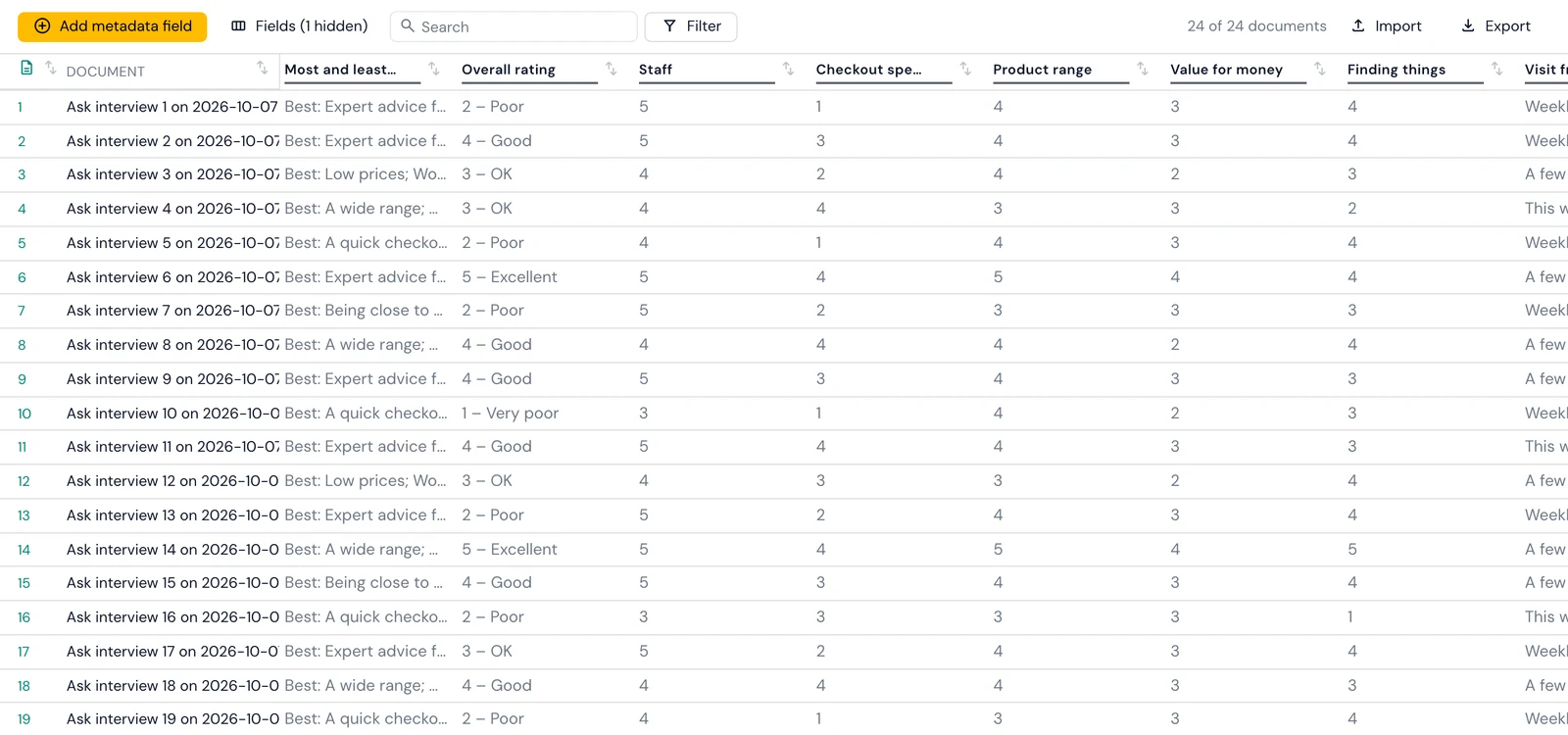
In this example the closed answers already tell a story. Weekly shoppers rated their last visit 2.4 out of 5 on average and the checkout 1.8, while every other group averaged between 3.3 and 4.3 overall. The most loyal customers are the least happy ones.
Step 3: open answers become themes
The open answers are coded passage by passage. Each passage becomes an insight, filed under a theme and linked to the quote it came from. In the first interview, "the staff were lovely as always" became an insight under staff friendliness, "I queued for nearly twenty minutes" and "only one till was open" went under till staffing and capacity, and "the self-checkout would not take the compost" went under self-checkout compatibility.
A Skimle Ask project starts with an analysis built from your questions, so each open question gets its own branch of themes. We also ran Skimle's identified themes analysis, which ignores the question structure and builds categories from what people said. Across the 24 interviews it produced 106 insights in 10 categories: checkout speed and queues led with 20 insights (till staffing alone had 8), followed by staff expertise and service with 13, and pricing, click and collect, store navigation, opening hours, loyalty and workshops behind them. Each category comes with a written summary whose claims cite the insights behind them.
Step 4: get numbers out of the conversations
This is the part that makes "qual at scale" useful to people who need a number for a slide. You can add a metadata field that Skimle fills by reading each conversation. We added two:
- What would bring them back, with allowed values such as faster checkout, click and collect, loyalty scheme, longer opening hours and clearer signage, and the instruction "the one change the respondent says would make them visit more often".
- Considered leaving without buying, with values left, considered it, no, or not mentioned.
The preview runs on a sample first, so you can check the instructions before filling all 24.
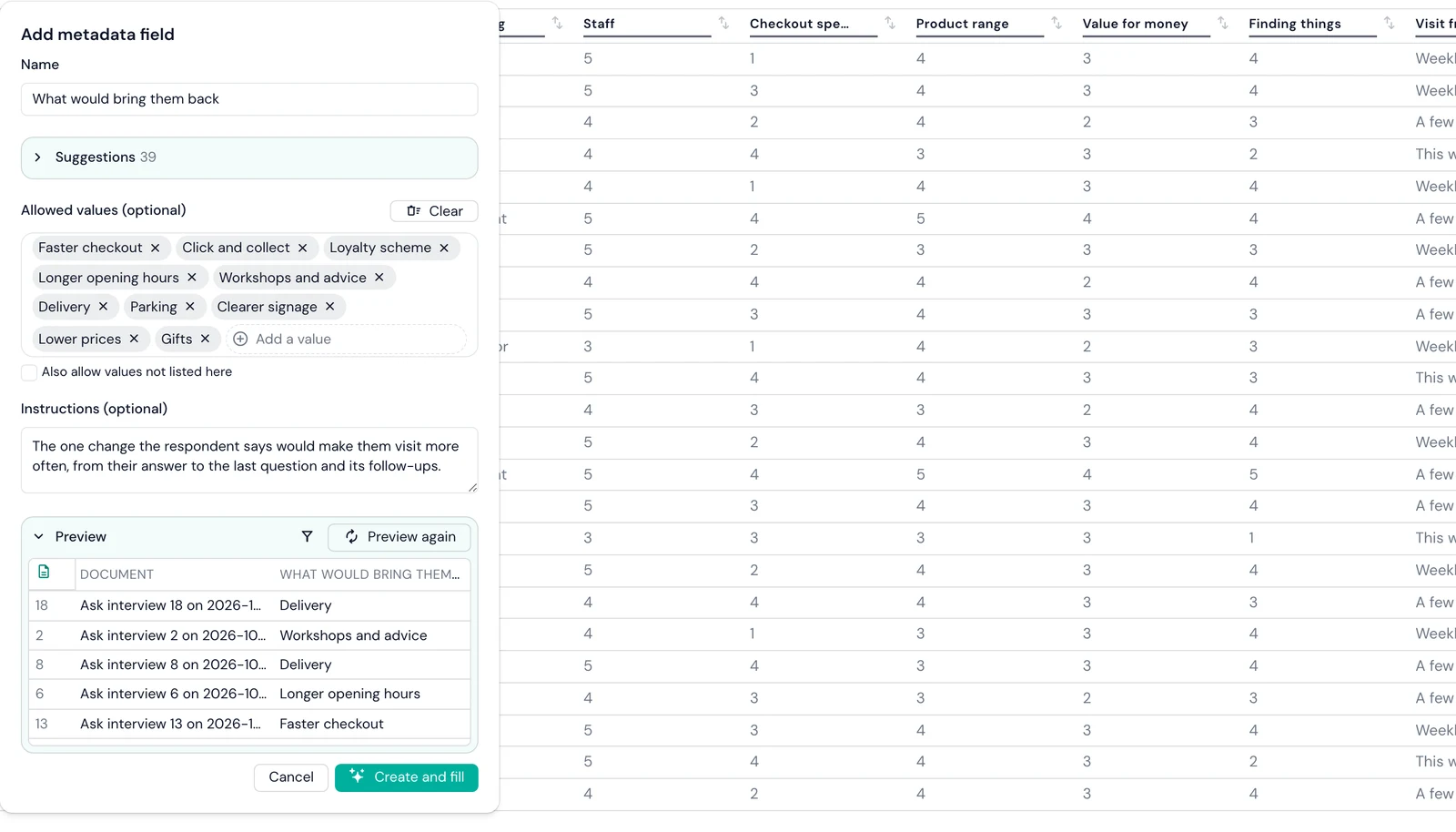
Once filled, an open question behaves like a closed one. The chart below counts insights by the value of the new field: a faster checkout leads, and clearer signage, click and collect and longer opening hours follow.
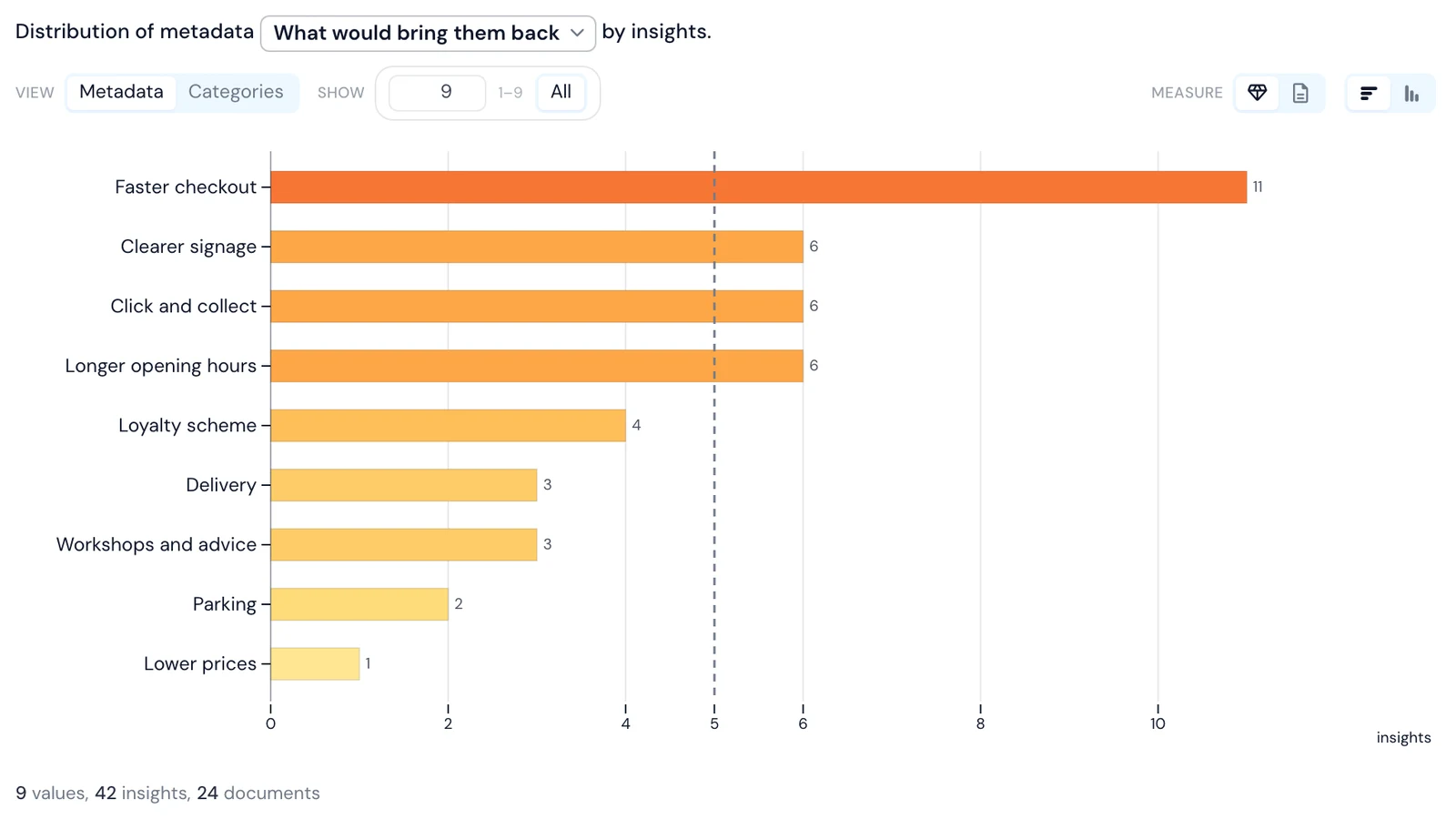
The leaving field produced the most striking number: 7 of the 9 weekly shoppers said they had left without buying or seriously considered it, against none of the other 15. Nobody was asked that question. It came out of what people said about the queue. With 24 respondents that is a direction, not a measurement: before acting on a split like this in a real study you would want at least a few dozen people in each group, and our guide on how many AI-moderated interviews you need covers the sizing.
Treat AI-filled values like any coded data and spot-check them. In our run one shopper who said they drive to the retail park when it rains (because they cannot park) was filled as "left without buying". That reading is defensible, but it is not what the field meant, so we recoded it to "no". Every value links back to the conversation, so a check takes seconds. See two-way transparency for why that traceability matters.
Step 5: compare groups and read why
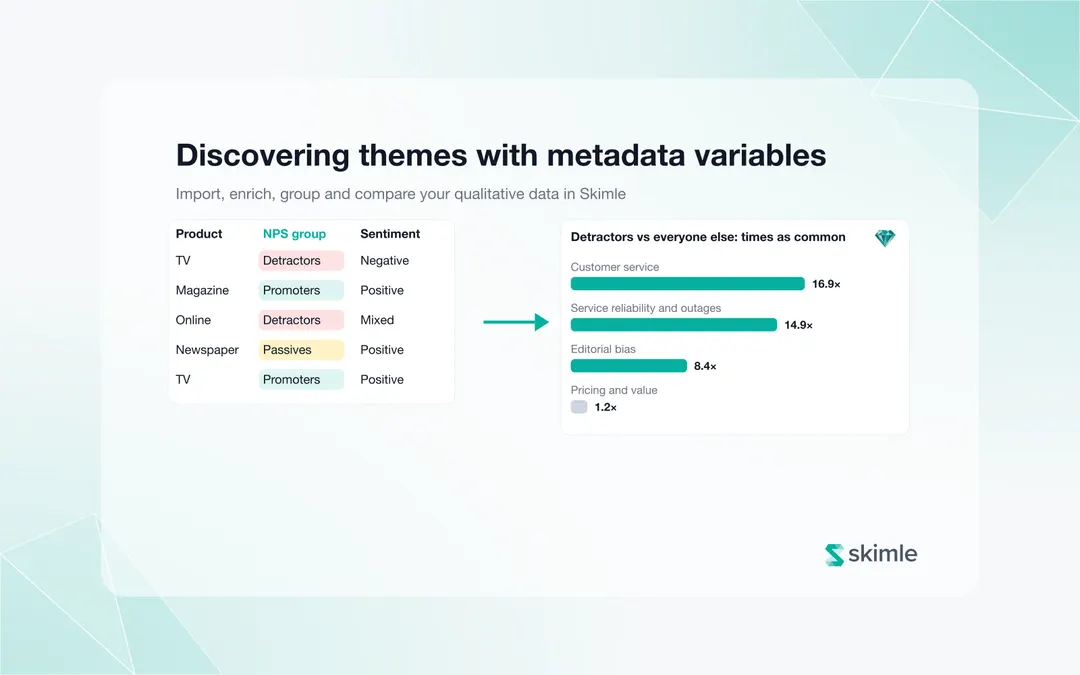
With closed answers and coded themes in the same project, you can cut one by the other. The heatmap below lays the themes against visit frequency. Eight of the nine insights about checkout waits come from weekly shoppers, and the first-time visitors talk about signage and finding things instead.
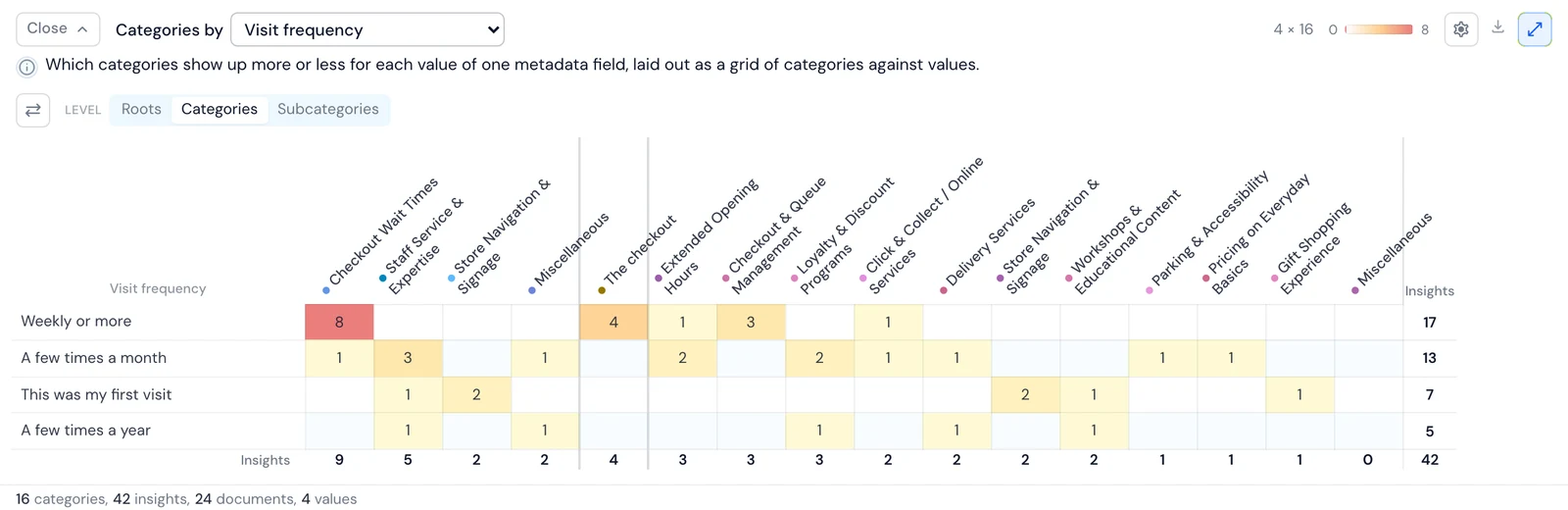
Clicking any cell opens the quotes behind it. The guide to metadata variables walks through the comparison and heatmap views on a larger dataset, and the visualisations docs cover every chart.
For Harbour Street, the result fits on one slide: weekly shoppers are the least satisfied group because of a Saturday checkout bottleneck, most of them have nearly walked out over it, some already buy compost elsewhere, and the fix they ask for is a second till between ten and one. Each of those claims has a number and a quote behind it.
What else can Skimle Ask do?
Beyond question types and branching, the features that matter most for running Ask at scale:
- 17 interview languages. Pick the languages respondents may answer in, and questions, options and messages are translated automatically. Answers come back in the respondent's language and are analysed in one project.
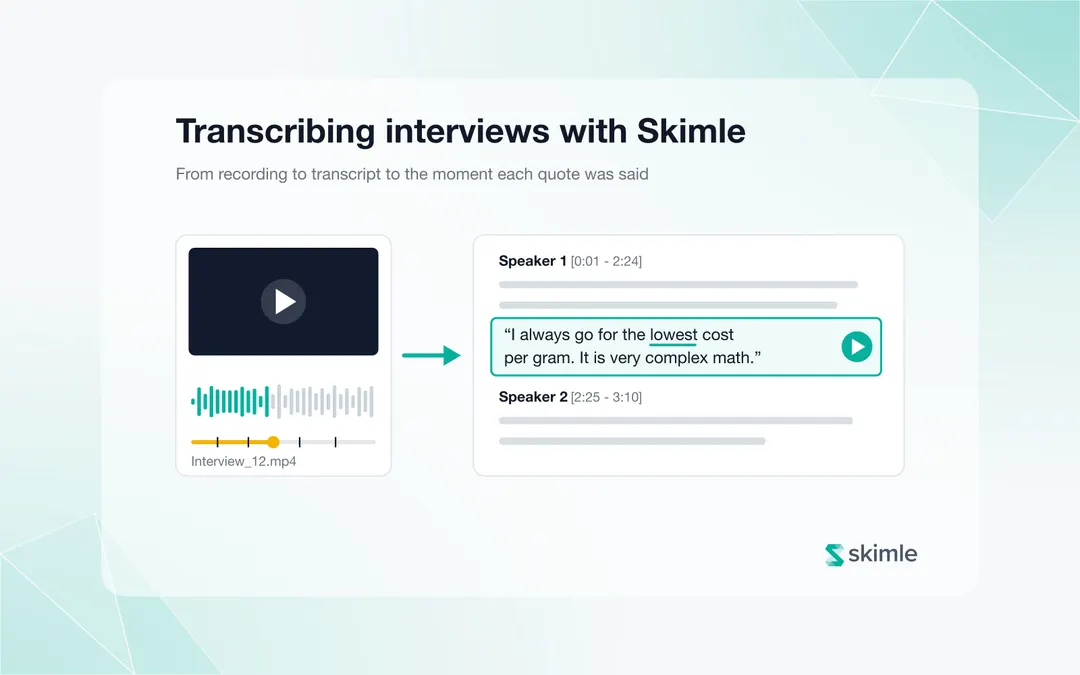
- Voice and video answers. Respondents can type, dictate, or record. You can switch voice or video recording off, suggest it, or require it, and recordings are transcribed and playable next to the transcript.
- Anonymous or identified. Interviews are anonymous by default; you choose whether to collect email addresses and write the privacy notice respondents see.
- Personal invitation links. Upload a CSV or Excel list of people and Skimle creates a personal link for each, tracks who has started and responded, and attaches what you know about them (department, customer tier) as metadata. You can restrict the interview to invited people only.
- Import and export guides. Import an existing interview guide from Word, PDF, Excel or a text file and Skimle turns it into questions, or export yours as a Word document to share with colleagues.
- Preview before sending. A preview link opens a fresh run of the interview that saves nothing, so you can test branches and follow-ups yourself.
- Share anywhere. A link, a short six-character code, or an embed on your website.
How do you launch your first Skimle Ask in 6 steps?
- Decide the one thing you need to know. "What would make customers visit more often?" works better than a list of topics. A five-minute interview has room for one or two real questions.
- Describe it in a sentence. Skimle drafts a guide with open and closed questions. Reword anything that does not sound like you.
- Use closed questions for the segments and scores you will want to cut by. Visit frequency, overall rating, customer type. Keep them to a handful; each one is a column later. If you run the interview in waves, keep the closed questions word for word the same so the columns can be tracked over time.
- Put AI follow-ups where the reasons are. Under the overall rating and under your main open question, with instructions on what to probe for. Leave follow-ups off questions you only included for completeness.
- Add a branch where only some people should be asked. Low checkout score goes to the checkout question; everyone else skips it.
- Preview, then share. Run the preview yourself, set the suggested time, write a two-line intro saying who is asking and why, and share the link where your people already are: a receipt QR code, an email, a Slack channel.
For more on writing questions that produce good answers, see our guide on how to write a good interview guide and on open-ended questions.
When should you use Skimle Ask?
- Customer experience and satisfaction studies where you need both a score and its reasons
- NPS or CSAT programmes that keep producing a number nobody can explain (see how to analyse NPS verbatims)
- Checking how a team feels about a proposal, a reorganisation or a return-to-office plan
- A first pass on a research question before deciding whether it deserves full depth interviews
- Continuous feedback across the customer lifecycle, as in always-on customer research
Frequently asked questions
What does "qual at scale" mean?
Qual at scale means collecting qualitative, open-ended answers from far more people than interviews normally reach, typically hundreds or thousands, by having an AI conduct short structured conversations. The trade-off is depth per person: a five-minute AI interview goes deeper than a survey text box but not as deep as a 45-minute conversation with a skilled researcher.
Can Skimle Ask combine rating scales with open questions?
Yes. Skimle Ask has eight question types, including multiple choice, rating grids, sliders, rankings and best-and-worst, alongside open questions. Any closed question can have an AI follow-up that asks why the respondent chose that answer, and closed answers can branch the interview to different questions.
How do you get quantitative data from qualitative interview replies?
Closed answers in Skimle Ask become metadata columns automatically when responses are confirmed. For open answers, you add a metadata field with allowed values and instructions, and Skimle fills it by reading each conversation, so "what would bring you back" becomes a countable variable. Every value links back to the conversation it came from.
Is Skimle Ask the same as Anthropic Interviewer?
No. Both are built on the same idea, an AI conducting an adaptive conversation instead of a static form, but Anthropic Interviewer is Anthropic's research tool for studying how people use Claude. Skimle Ask is a product anyone can use for any topic, with the analysis built into the same project.
How long does a Skimle Ask interview take to set up and answer?
Drafting and editing a guide like the six-question example here takes 10 to 20 minutes. Respondents typically spend 3 to 10 minutes, depending on the suggested time you set and how many follow-ups you allow.
Is it free to try?
Yes. Creating and sending a Skimle Ask interview is free, and Skimle's free plan covers the analysis for smaller projects.
Ready to find out why your customers score you the way they do? Try Skimle Ask for free and get your first answers back, already organised into themes and columns, within the hour.
Want to go deeper? Read how Skimle Ask was introduced and how it works end to end, how many AI-moderated interviews you need, and how to analyse open-text responses at scale.
About the authors
Henri Schildt is a Professor of Strategy at Aalto University School of Business and co-founder of Skimle. He has published over a dozen peer-reviewed articles using qualitative methods, including work in Academy of Management Journal, Organisation Science, and Strategic Management Journal. Google Scholar profile
Olli Salo is a co-founder at Skimle and former Partner at McKinsey & Company where he spent 18 years helping clients understand their markets, develop winning strategies and improve their operating models. He has done over 1000 client interviews and published over 10 articles on McKinsey.com and beyond. LinkedIn profile
Sources
- Galesic, M. and Bosnjak, M. (2009). Effects of questionnaire length on participation and indicators of response quality in a web survey. Public Opinion Quarterly, 73(2), 349-360
- Xiao, Z. et al. (2020). Tell me about yourself: using an AI-powered chatbot to conduct conversational surveys with open-ended questions. ACM Transactions on Computer-Human Interaction
- Introducing Anthropic Interviewer: what 1,250 professionals told us about working with AI - Anthropic
- What 81,000 people want from AI - Anthropic